A D&C is not a single procedure or an automatic response to miscarriage, heavy bleeding or retained tissue. The right plan depends on the diagnosis, pregnancy status, treatment alternatives, anaesthesia, facility support and follow-up. By the end, you will know what to ask before booking and which warning signs require urgent care.
Key takeaways
- Ask why D&C is recommended and whether retained tissue, bleeding or abnormal tissue is the cause.
- Confirm whether hysteroscopy or an office biopsy could answer the same clinical question.
- Arrange transport home if sedation or general anaesthesia is planned.
- Seek urgent review for heavy bleeding, fever, worsening pain, fainting or foul-smelling discharge.
When is a D&C the right treatment?
A D&C is appropriate when tissue remains in the uterus, bleeding needs investigation or control, or a focal abnormality requires removal. An obstetrician-gynaecologist may recommend it for retained tissue after miscarriage or delivery, prolonged postpartum bleeding, heavy or abnormal uterine bleeding, an insufficient office endometrial biopsy, or selected polyps and abnormal uterine tissue.
Before scheduling a d and c procedure in Mumbai, confirm pregnancy location and gestational age with pelvic ultrasound. Serial beta-hCG testing may be needed when an early pregnancy is unclear. An ectopic pregnancy is outside the uterus and is not treated with an ordinary uterine D&C.
| Situation | When D&C may fit | What may come first or differ |
|---|---|---|
| After miscarriage | Retained pregnancy tissue causes ongoing bleeding or infection risk | Watchful waiting, misoprostol, or manual or vacuum aspiration; timing and follow-up depend on ultrasound and symptoms |
| After delivery | Retained placental tissue or prolonged postpartum bleeding needs treatment | Stabilisation, ultrasound and medication may come first; preparation differs from miscarriage care |
| Abnormal bleeding | Sampling remains inadequate or tissue must be removed | Medication, office biopsy or hysteroscopy-directed treatment may be better |
| Polyp or abnormal tissue | A selected lesion needs removal or histopathology | Hysteroscopy can target it under direct vision |
“D&C” may mean suction aspiration, curettage, or both. Early-pregnancy surgical care often uses vacuum aspiration rather than sharp curettage alone; WHO recommends vacuum aspiration before 14 weeks and dilation and evacuation at 14 weeks or later for surgical abortion. A dilation and curettage in Mumbai consultation should match treatment to the confirmed diagnosis.
What happens before, during and immediately after the procedure?
A dilation curettage consultation in Mumbai begins by confirming why the procedure is needed, not by booking it automatically. You review examination findings, ultrasound results, alternatives, expected benefits and risks, then give informed consent.
1. Tell the clinician about aspirin, anticoagulants, allergies, medical conditions and your blood group. If pregnancy is possible, pregnancy testing and confirmation of pregnancy location may be necessary.
2. If sedation or general anaesthesia is planned, the anaesthesia team gives fasting instructions, identifies who will provide anaesthesia and explains monitoring. Local anaesthesia, sedation, regional anaesthesia or general anaesthesia may be used, depending on the procedure, gestational age, medical history, preference and facility capability.
3. The cervix may be prepared with medication or another method selected for your circumstances. This reduces resistance during cervical dilation.
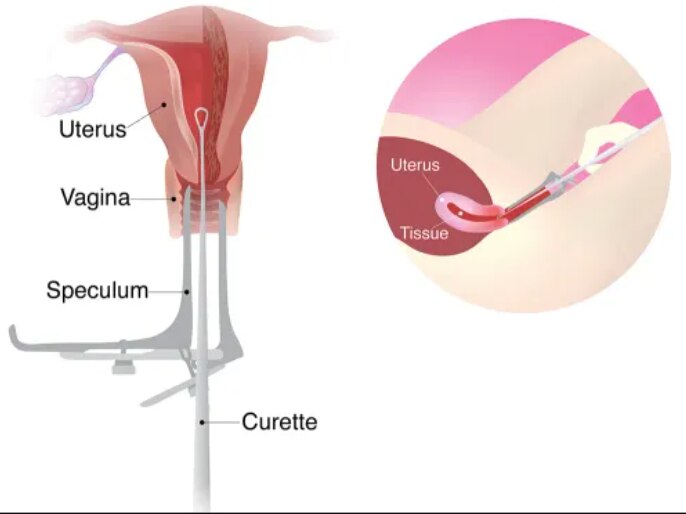
4. D&C describes more than one technique. The clinician may use suction aspiration, a curette, or both to remove uterine tissue. Ask which method is planned and why.
5. After cervical dilation and tissue removal, you move to a recovery area. Staff monitor bleeding, pain, blood pressure, breathing and alertness before discharge; sedation or general anaesthesia usually requires an escort and no driving afterward.
6. The removed tissue may be labelled and sent for histopathology when investigating abnormal bleeding, suspected retained products or abnormal pregnancy tissue. The report examines the submitted tissue; it does not replace the examination, ultrasound or procedure findings. Ask when results will be available and how they will be communicated.
How does D&C compare with hysteroscopy and other tissue tests?
D&C removes or collects uterine tissue, but it does not directly show the uterine cavity while tissue is being taken. Hysteroscopy passes a camera through the cervix, so the clinician can see and target an endometrial polyp, fibroid or other lesion before treating it under direct vision.
| Option | What it does | When it fits |
|---|---|---|
| D&C | Removes tissue with suction, a curette, or both | Retained tissue, selected abnormal bleeding, or insufficient office sampling |
| Hysteroscopy | Shows the cavity and treats a visible focal lesion | Polyp, submucosal fibroid, or suspicious lesion |
| Office endometrial biopsy | Samples lining tissue without removing retained tissue | Abnormal bleeding needing diagnostic sampling |
| Manual vacuum aspiration | Removes pregnancy-related tissue by suction | Selected early-pregnancy loss or abortion care |
| Medication or observation | Allows tissue to pass without instrumentation | Appropriate early loss or bleeding when the patient is stable |
A histopathology report is not the same as the operation. It describes what the laboratory sees in the submitted tissue; it cannot replace the examination, ultrasound or procedure findings. During a dilation and curettage in Mumbai, ask:
- Will tissue be sent for histopathology?
- What can the report establish, and what cannot it establish?
- When will results be available?
- How will the clinician communicate them?
For abnormal bleeding, an office biopsy or hysteroscopy may avoid a D&C. For selected early pregnancy loss, medication or observation may also avoid instrumentation.
What recovery is normal, and which symptoms need urgent review?
Cramping and light bleeding or spotting for several days are common after a D&C. Recovery is not identical for everyone, so follow the treating clinician’s and anaesthesia team’s written plan for pain relief, bathing, exercise, work, driving, vaginal intercourse, tampon use and restarting medicines.
| Symptom | Usually expected | Seek urgent medical review |
|---|---|---|
| Bleeding | Light bleeding or spotting | Soaking about two large sanitary pads per hour for two consecutive hours; facility instructions take precedence |
| Pain | Mild, period-like cramps that improve | Severe or worsening abdominal pain |
| General symptoms | Gradual return to normal | Fainting, marked dizziness, fever, chills, foul-smelling discharge or persistent pregnancy symptoms |
Menstruation returns after the body recovers, but timing depends on why the D&C was performed and whether pregnancy was involved. Follow-up may include symptom review, an ultrasound or discussion of histopathology results.
Uncommon complications include infection, haemorrhage, cervical injury, uterine perforation and anaesthetic complications. Intrauterine adhesions, also called Asherman syndrome, can follow uterine instrumentation and cause scant or absent periods, infertility or recurrent miscarriage. Persistent changes need assessment rather than automatically repeating curettage.
If you are arranging a d and c procedure in Mumbai, confirm who to contact after discharge and where emergency care is available.
What should you ask during a D&C consultation in Mumbai?
Start by asking the d and c doctor in Mumbai to state the confirmed indication in plain language. Ask whether pregnancy location and gestational age were checked with ultrasound and, when needed, serial beta-hCG testing; an ectopic pregnancy needs different emergency treatment.
Compare alternatives against the proposed plan:
| Option | What it means | When it applies |
|---|---|---|
| Watchful waiting | Time for tissue to pass naturally | Stable miscarriage with no urgent bleeding or infection |
| Misoprostol | Medicine that helps the uterus expel tissue | Selected early-pregnancy loss or abortion care |
| Vacuum aspiration | Suction removal of uterine contents | Many early-pregnancy procedures |
| Office biopsy | Small sample without operative evacuation | Abnormal bleeding needing sampling |
| Hysteroscopy | Camera-guided inspection and treatment | A visible polyp, fibroid or focal lesion |
During a dilation curettage consultation in Mumbai, ask which technique will be used—suction aspiration, curette, or both—who will provide local anaesthesia, sedation, regional anaesthesia or general anaesthesia, what monitoring is available, and how long the procedure and full recovery may take.
Ask whether the facility has ultrasound access, histopathology arrangements, emergency treatment and referral pathways for perforation, haemorrhage, infection and ectopic pregnancy. For abortion care, ask how India’s Medical Termination of Pregnancy framework applies to gestational age, provider eligibility and facility registration.
An adult woman’s consent is generally the relevant consent; a husband’s consent is not a routine legal substitute.
Tell the clinician if you are RhD-negative and ask whether anti-D immunoglobulin is indicated. Her Space by Dr. Shifa can help connect diagnosis, procedure planning, anaesthesia questions, tissue testing and follow-up. Before leaving, obtain written restrictions, an emergency telephone number and the follow-up date or trigger.
Related service
OBSTETRICS Dilation & Curettage (D&C) by Dr. Shifa Anwar Panwala Dilation & Curettage (D&C) is a commonly performed gynecological procedure used to diagnose or... View service → |
Frequently asked questions
When is a D&C the right treatment?
A D&C may be recommended when tissue remains in the uterus after miscarriage or delivery, bleeding needs investigation or control, an office biopsy is insufficient, or selected polyps and abnormal tissue require removal.
What happens before, during and immediately after a D&C?
Before the procedure, the clinician reviews your symptoms, pregnancy status, medicines, medical history and anaesthesia plan. During D&C, the cervix is opened and tissue is removed from the uterus for treatment or laboratory testing. Afterward, you are monitored until the effects of anaesthesia or sedation reduce.
How does D&C compare with hysteroscopy and other tissue tests?
D&C removes tissue from inside the uterus but does not always show the exact location of a focal lesion. Hysteroscopy lets the clinician view the uterine cavity directly and target a polyp or other abnormality. An office endometrial biopsy uses a small sample without a surgical procedure, but it can miss focal lesions or provide insufficient tissue.
What recovery is normal, and which symptoms need urgent review?
Light bleeding and cramping can occur after D&C. Follow your clinician’s instructions about activity, intercourse, tampons and medicines. Seek urgent medical review for heavy bleeding, fever, worsening pain, fainting or foul-smelling discharge.
What should you ask during a D&C consultation in Mumbai?
Ask what caused the recommendation, whether hysteroscopy or an office biopsy is suitable, which anaesthesia will be used, how tissue will be sent for laboratory testing, when results are due, what recovery restrictions apply and which symptoms require urgent care.
Keywords